E-Lecture - Units of Measurements
Systems of Units
Making observations is fundamental to all science. A quantitative observation, or measurement, always consists of two parts: a number and a scale (called a unit). Both parts must be present for the measurement to be meaningful.
System (le Système International in French), or the SI system. This system is based on the metric system and units derived from the metric system. All other SI units of measurement can be derived from these base units. The fundamental SI units are listed in.
We use prefixes to indicate decimal multiples or fractions of the base units. The international system uses a series of prefixes to indicate decimal fractions or multiples of various units by powers of 10. All numbers can be expressed in the form of a × 10b, where ‘a’ is a number between 1 and 10, and the exponent ‘b’ is an integer.
Dimensional analysis was developed to ensure that our answers yield proper units. It also offers a systematic approach to solve numerical problems and check our solutions for possible errors.
In dimensional analysis, we carry units through all calculations. As we work, we multiply units together, divide them by each other, and ‘cancel’ them.
For example, 100 cm and 1 m are the same length, 100 cm = 1 m. This relationship allows us to write two conversion factors:
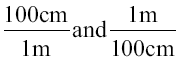
The first of these factors is used when we want to convert meters to centimeters and second centimeters to meters. For example, the length in centimeters of an object that is 8.50 m long is given by:
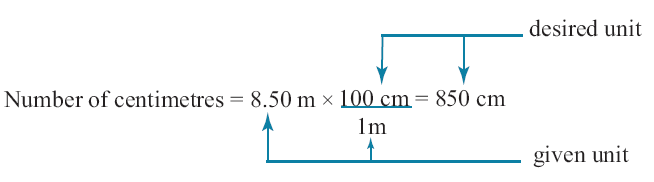
In general, the units multiply and divide as follows:
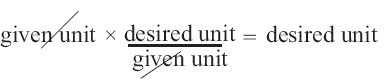
If the desired units are not obtained in a calculation, then we know that we made an error somewhere. Careful inspection of units often reveals the source of the error.
Scientific notation and Significant figures
Scientific notation is the representation of a number in the form A × 10n , where A is a number with a single non-zero digit to the left of the decimal point and n is an integer, or whole number. In scientific notation, the measurement 900 cm precise to two significant figures is written 9.0 × 102 cm. If precise to three significant figures, it is written 9.00 × 102 cm. Scientific notation is also convenient for expressing very large or very small quantities. It is much easier (and simplifies calculations) to write the speed of light as 3.00 × 10⁸ (rather than as 300,000,000) meters per second.
The following examples illustrate the use of scientific notation:
1. Express 568.762 in scientific notation:
568.762 = 5.68762 × 10²
Note that the decimal point is moved to the left by two places and n = 2.
2. Express 0.00000772 in scientific notation:
0.00000772 = 7.72 × 10⁻⁶
Next, we consider how scientific notation is handled in arithmetic operations.
Significant Figures
Except when all the numbers involved are integers (for example, in counting the number of students in a class), obtaining the exact value of the quantity under investigation is often impossible. For this reason, it is important to indicate the margin of error in a measurement by clearly indicating the number of significant figures, which are the meaningful digits in a measured or calculated quantity. When significant figures are used, the last digit is understood to be uncertain. For example, we might measure the volume of a given amount of liquid using a graduated cylinder with a scale that gives an uncertainty of 1 mL in the measurement.
The following guidelines apply to determining the number of significant figures in a measured quantity. It has to be decided whether zeros are significant in three different situations.
- If the zeros precede the first non-zero digit, they are not significant. Such zeros merely locate the decimal point. i.e., they define the magnitude of measurement. For example, 0.004 m has one significant figure, and 0.00016 m has two significant figures.
- If the zeros are between non-zero digits, they are significant. For example, 204408 kg has six significant figures while 0.05504 has four significant figures.
- If the zeros follow non-zero digits, there is ambiguity if no decimal point is given. For example, if a volume is given as 200 cm3, there is no way of expressing if the final two zeros are significant. But if the volume is given as 200 cm3, zeros after a non-zero digit preceded by a decimal point make all figures significant. Thus, 200 cm3 has three significant figures. If it is given as 200.0 cm3, it has four significant figures.
- Non-zero digits are always significant.
 Browse Chapter