E-Lecture - Metallic Bonding
In simple terms, metallic bonding is referred to as bonding in metal atoms. It is also defined as interaction between metal nuclei and the delocalized electrons.
Is a metal made up of atoms or ions?
The strength of the metallic bond depends on the:
- Number of electrons in the delocalised ‘sea’ of electrons. (More delocalised electrons results in a stronger bond and a higher melting point.)
- Packing arrangement of the metal atoms. (The more closely packed the atoms are the stronger the bond is and the higher the melting point.)
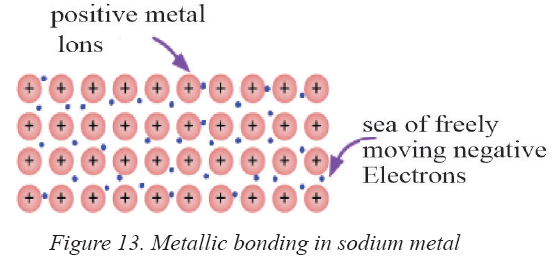
The bonding valence electrons move freely throughout the entire crystal. This freedom of movement is responsible for the electrical conductivity of metals.
Properties of metals related to the concept Metallic Bonding
Have you ever visited a goldsmith workshop? Why are metals easily shaped into thin sheets and drawn into wires?
The freedom of movement of bonding valence electrons is responsible for the high electrical and thermal conductivity that characterizes the metals. Other properties of metallic bonding contribute to unique properties of metals. For example, most metals are easy to shape due to their malleability and ductility.
Malleability allows a substance such as a metal to be reshaped. By hammering and bending some metals, you can create thin sheets. Ductility allows a substance to be drawn or pulled out into long thin pieces, such as wires. Metals are malleable and ductile because metallic bonding is the same in all directions throughout the solid.
When we apply a force to metal, its cations swim freely within the sea of electrons without breaking the crystal structure. For example, when you hammer, bend, or pull on a metal to reshape it, you shift its cations around. The force you apply moves the atoms around, for example, around corners in the lattice. This is the basis for malleability and ductility of metals, which allows you to change its shape.
 Browse Chapter