E-Lecture - Coordinate Covalent Bond
A covalent bond in which one atom donates both electrons of the bond is called a coordinate covalent bond. It is also called a dative bond. Such a bond is hypothetically represented as:

Once formed, a coordinate covalent bond has the same properties as any other covalent bond. The atom that contributes both electrons for the bond is the donor atom, and the atom that shares the electron pair is the acceptor atom.
For example, the ammonium ion, NH4+, is formed by a coordinate covalent bond in which the two non-bonding electrons on NH3 bond with a hydrogen ion, H+, which has no electrons to contribute.
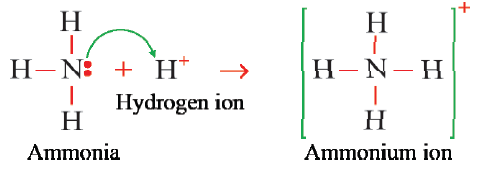
In the resulting ion, NH4+, the four N – H bonds are identical.
Similarly, a coordinate covalent bond can be formed between a hydrogen ion and a molecule of water, which has two lone pairs of electrons.
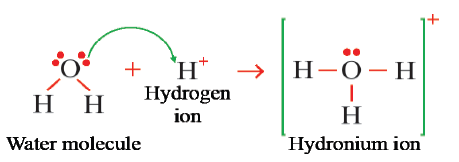
Carbon monoxide, CO, also has a coordinate covalent bond. In order for both carbon and oxygen atoms to attain noble-gas electronic arrangements, oxygen donates a pair of electrons to the carbon atom. In the process a coordinate covalent bond is formed between the two atoms.

 Browse Chapter