E-Lecture - Polygonal Arithmetic
Number patterns have interested mathematicians from the time of the ancient Greeks. Some of this interest centered around the relations between number expressed geometrically and algebraically. This idea is basic to the study of polygonal numbers.
Polygonal numbers are nonnegative integers represented by geometrical arrangements of equally spaced points that form regular polygons. The most common and basic types of polygonal numbers are triangular, square, pentagonal and hexagonal numbers.
Polygonal figurate numbers or simply polygonal numbers are the numbers which can be arranged as regular polygon such as equilateral triangle, square, pentagon, hexagon, etc. So, polygonal numbers include triangular numbers, square numbers, pentagonal numbers, hexagonal numbers, and so on.
If we represent using “dots” there are special numbers that can form “polygon”. Numbers that can form polygons are called polygonal numbers.
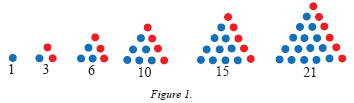
Continuing with this augmenting arrays of well arrenged dots forming an expanded equilateral triangle with respective sum of dots in each such triangle, results in a sequence of numbers 1, 3, 6, 10, 15, 21, 28, . . . known as triangular numbers.
 Browse Chapter