E-Lecture - pH and pOH calculations
Upon completion of this topic, learners will be able to:
- solve sample problems involving the concept of pH and pOH.
- calculate the pH of a solution given [H+] or [OH-].
- calculate the pH of a strong acid or strong base given its concentration.
- calculate Ka or Kb for a weak acid or weak base given its concentration and the pH of the solution.
- calculate the pH of a weak acid or weak base or its percent ionization given its concentration and Ka or Kb.
Notice that pH increases as [H+] decreases. A change in by a factor of 10 causes the pH to change by 1. Thus, the concentration of [H+] in a solution of pH 6 is 10 times the [H+] in a solution of pH 7.
Suppose that you are given the pH of a solution. How can you determine its hydronium ion concentration?
Calculating the pH of strong acids
In an aqueous solution of a strong acid, the acid is normally the only significant source of H+ ions. As a result, calculating the pH of a solution of a strong monoprotic acid is straightforward because [H+] equals the original concentration of acid.
Calculating the pH of strong bases
Which solution has the higher pH, a 0.001 M solution of NaOH or a 0.001 M solution of Ba(OH)2?
Calculating the pH of weak acid solutions
Most acidic substances are weak acids and therefore only partially ionized in aqueous solution. We can use the equilibrium constant for the ionization reaction to express the extent to which a weak acid ionizes.
As we did for the ion-product constant for the auto ionization of water, we change the subscript on this equilibrium constant to indicate the type of equation to which it corresponds:

The subscript ‘a’ denotes that Ka is an equilibrium constant for the ionization of an acid, so Ka is called the acid-dissociation constant.
Larger the value of Ka, stronger the acid. Chlorous acid (HClO2), for example, is the strongest acid in, and phenol (HOC6H5) is the weakest.
Use of Ka to calculate pH of an acid
How do you calculate the pH of weak acids?
Generally, we can calculate the hydrogen-ion concentration or pH of an acid solution at equilibrium, given the initial concentration of the acid and its Ka value.
The following may help you to solve weak-acid dissociation problems.
- Identify the major species that can affect the pH of the solution. In most cases we can ignore the dissociation of water. Why?
- Write balanced equations for the reactions producing H3O+.
- List the initial concentration of the species participating in the equilibrium.
- Define the change needed to achieve equilibrium. That is, define x.
- Write the equilibrium concentration, in terms of x.
- First solve for x by the approximation method. If the approximation is not valid, use the quadratic equation.
Let’s calculate the pH at 25°C of a 0.30 M solution of acetic acid (CH3COOH), the weak acid responsible for the characteristic odor and acidity of vinegar.
1. Our first step is to write the ionization equilibrium:
CH3COOH(aq) ⥨ H+(aq) + CH3COO-(aq)
2. The second step is to write the equilibrium-constant expression and the value for the equilibrium constant. Taking Ka = 1.8 × 10⁻⁵ from we write:

3. The fourth step is to substitute the equilibrium concentrations into the equilibrium-constant expression and solve for x:

This expression leads to a quadratic equation in x, which we can solve by using a quadratic equation. We can simplify the problem, however, by noting that the value of Ka is quite small. We can (and should!) check the validity of this assumption when we compute the problem. By using this assumption, Ka becomes
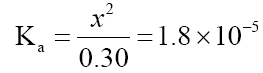
Solving for x, we have

4. As a general rule, if x is more than about 5% of the initial concentration, it is better to use the quadratic formula. You should always check the validity of any simplifying assumptions after you have completed solving a problem.
 Browse Chapter