E-Lecture - Lateral Conjugation
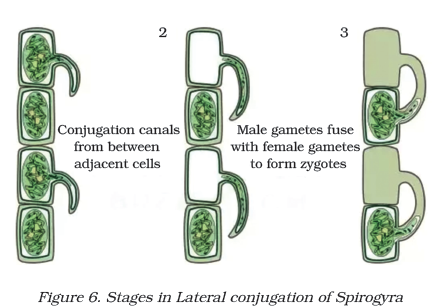
In lateral conjugation, adjacent cells of a Spirogyra species function as male and female gametes. Conjugation tubes are formed between cells of the same filament.
Lateral conjugation is of two types:
Direct lateral conjugation: Passage is formed between two adjacent cells through the middle lamella. Male gametes fuse with female gametes. Zygotes are formed in alternate cells.
Indirect lateral conjugation: The conjugation canal is formed by the cell having male gamete and joins the adjacent cell having female gamete.
The zygote in Spirogyra is known as zygospores. Zygospores are diploid (2n) and formed by the fusion of male and female gametes. Zygospores are the only diploid stage in the life cycle of Spirogyra.
The zygospore remains dormant until favorable conditions are available. At the time of germination, the zygospore undergoes meiosis to form 4 haploid (n) nucleus, of which only one survives and others disintegrate. Developing zygospore burst open to form germ tube. The germ tube divides repeatedly by transverse division and develops into a new haploid filament of Spirogyra.
 Browse Chapter