E-Lecture - Beats
When two sound waves having slightly different frequencies are sounded together, the combined sound grows and falls in loudness. The principle of superposition tells us that the waves reinforce one another when they arrive in phase and cancel out when they arrive out of phase. When reinforcement occurs a louder sound is heard and when cancellation occurs a soft sound or no sound at all is heard. This variation in loudness of a sound heard is called beat.
The simplest illustration of beat is to draw two different waves and then add them together. You can do this by drawing them yourself to see the pattern that occurs.
Here is wave 1:
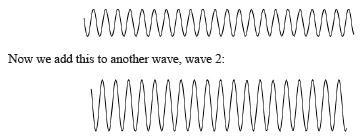
When the two waves are added the resulting wave is drawn below. Notice that the peaks are the same distance apart but the amplitude changes. If you look at the peaks, the peak amplitudes seem to oscillate with another wave pattern.
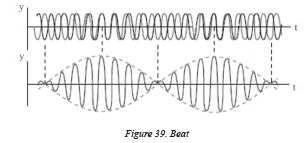
The beats have a frequency which is the difference between the frequency of the two waves that were added. If two sound waves have frequencies f1 and f2, then the number of beats per second, called the beat frequency (fb) is given by: fb = | f1- f2 |
 Browse Chapter