E-Lecture - Important Points
- A quadratic function is a function of the form y = f (x)= ax2 + bx + c, where a, b and c are real numbers with a ≠ 0.
- The domain of a quadratic function is the set of all real numbers, ℝ.
- In interval notation, the domain of any quadratic function is (-∞, ∞).
- An equation that can be written in the form ax2 + bx + c = 0, where a, b and c are real numbers with a ≠ 0, is called a quadratic equation in x. The given form is called standard form.
- If the product two numbers is zero, then one of these factors must be zero. That is, for any real numbers p and q, if p × q = 0, then either p = 0 or q = 0.
- To factorize a general quadratic expression, x2 + bx + c = 0, a ≠ 1 it is recommended to follow the following three steps.
Step 1: Find the product of a × c,
Step 2: Find pairs of factors of a × c
If a × c is positive, find a pair whose sum is b.
If a × c is negative, find a pair whose difference is b.
Step 3: Write b in terms of the sum of the pair and then factorize again. - To solve word problems, we follow the following steps.
Step 1: Read the problem carefully and draw diagram whenever possible.
Step 2: List all of the unknown numerical quantities involving in the problem and call it any letters such as p, q, y, z etc.
Step 3: Using information given in the wording of the problem, set up a word equation that contains words as well as numbers.
Step 4: Put in numbers in place of words whenever possible to set up an algebraic equation containing one variable and known numerical constant.
Step 5: Solve the equation for the variable. - To solve a quadratic equation using completing the square method, we follow the following steps.
Step 1: Write the given quadratic equation in the standard form.
Step 2: Make the coefficient of x2 equal to 1, if it is not.
Step 3: Shift the constant term to right hand side (R.H.S) of the equation.
Step 4: Add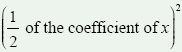 to both sides of the equation.
Step 5: Express the left-hand side (L.H.S) as the perfect square of a suitable binomial expression and simplify the right-hand side (R.H.S).
Step 6: Take square root of both sides.
Step 7: Obtain the values of x by shifting the constant term from L.H.S to R.H.S. - Features of the graph of quadratic function.
(i) The orientation of a parabola is that it either opens up or opens down.
(ii) The vertex is the lowest point or the highest point on the graph.
(iii) The axis of symmetry is the vertical line that goes through the vertex. If h is the x-coordinate of the vertex, the equation for the axis of symmetry is x = h.
(iv) The maximum or minimum value of a parabola is the y-coordinate of the vertex.
(v) The y-intercept is the point at which the parabola crosses the y-axis.
(vi) The x-intercepts are the points at which the parabola crosses the x-axis. The domain of a quadratic function is all real numbers, (-∞, ∞).
(vii) The range of a quadratic function starts or ends with the value of the y-coordinate of the vertex. - The graph of a quadratic function f (x)= ax + bx + c has a minimum turning point with a > 0 and a maximum turning point when a < 0. The turning point lies on the line of symmetry.
 Browse Chapter