E-Lecture - Solving Quadratic Equations by Factorization
To solve a quadratic equation, ax2 + bx + c = 0, we must find values of the unknown variable x which make the left-hand and right-hand sides equal. Such values are known as solutions or roots of the quadratic equation.
Factored quadratic equation can be solved using the zero-product principle.
Zero-Product principle
If the product two numbers is zero, then one of these factors must be zero. That is, for any real numbers p and q, if p × q = 0, then either p = 0 or q = 0.
To solve the quadratic equation ax2 + bx + c = 0, we factorize the expression ax2 + bx + c into linear factors, whenever possible, and solve the linear equation using the fact that p × q = 0.
1. Solving Quadratic Equations of the form ax2 + bx = 0 by Factorization
The quadratic expression of the form ax2 + bx = 0 can be factorized as:
ax2 + bx = 0
x (ax + b) = 0
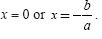
x = 0 or ax + b = 0
2. Solving Quadratic Equations of the form a2x2 - b2 = 0 by Factorization.
Using the difference of two squares formula: a2 - b2 = (a + b) (a - b), the quadratic equation of the form x2 - k2 = 0 can be factorized as (x + k)(x - k) = 0 which implies that x = -k or x = k.
 Browse Chapter