E-Lecture - Ground Tissue
Ground tissue makes up much of the interior of a plant and carries out basic metabolic functions. Ground tissue in stems provides support and may store food or water. Ground tissues in roots may also store food. Ground tissue is often divided into three cell types:
(i) Collenchyma tissue is found chiefly in the cortex of stems and in leaves and is the primary supporting tissue for many herbaceous plants. Collenchyma is living supportive tissue that has elongated cells and an unevenly thickened primary cell wall.

(ii) Parenchyma – These tissues are found in the soft parts of a plant such as the roots, stems, leaves, and flowers. Parenchyma tissues are typically composed of living cells that are thin-walled, unspecialized in structure, and therefore adaptable, with differentiation, to various functions. The cells of this tissue are loosely packed and contain large intercellular spaces between them. Each cell has a vacuole at the center.

Vascular tissues
Vascular tissue is the plumbing system of the plant. It allows water, minerals, and dissolved sugars from photosynthesis to pass through roots, stems, leaves, and other parts of the plant. It is primary composed of two types of conducting tissue: xylem and phloem.
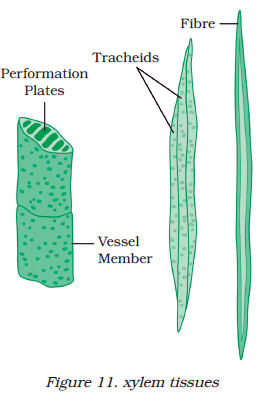
Xylem : It consists of tracheids, vessels, and xylem parenchyma and xylem fibers. Tracheids and vessels are hollow tube-like structures that help. There are two type of tracheary elements: vessel elements and tracheids. The xylem parenchyma is responsible for storing the prepared food and assists in the conduction of water. Xylem fibers are supportive.
 Browse Chapter