E-Lecture - Relationship between Kp & Kc
If concentrations are provided, Kc is easier to use. If the problem makes use of partial-pressure data, then Kp is generally more convenient. But if the equilibrium constant is in one set of units and the concentrations are in the other, then we must convert either the concentrations or the equilibrium constant to match.
Relation between Kc and Kp
For the general reaction:
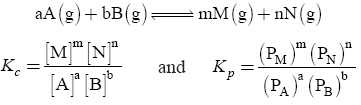
It is assumed that all the gaseous species behave like an ideal gas. The relationship between the partial pressure of a gas and its molar concentration comes from the ideal gas law:
PV = nRT
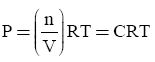
Where, n/V = C is the molar concentration-the units are moles per liter, n = amount of the gaseous species in moles, R = Gas constant, T = Temperature in kelvin, V = Volume of the reaction mixture, and C = Molarity.
For the pressure of any species, substitute [n/V] × RT for P
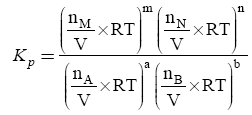
We can substitute square brackets for 
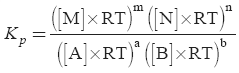
and collect all the RT terms:
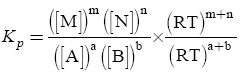
We can recognize that the first term is equal to Kc
Kp = Kc × (RT)m+n–a–b
and the second term is (RT)∆n, so
Kp = Kc (RT)∆n
here Δn = (m + n) – (a + b) for gaseous species.
When the number of gaseous reactants and products are equal then, a + b = m + n. Therefore, Δn = 0 and hence Kp = Kc.
 Browse Chapter