E-Lecture - Important Points
A chemical reaction can be in a state in which the forward and reverse processes occur at the same rate. This condition is called chemical equilibrium, and it results in the formation of an equilibrium mixture of the reactants and products of the reaction. The composition of an equilibrium mixture does not change with time if temperature is held constant.
The relationship between the concentrations of the reactants and products of a system at equilibrium is given by the law of mass action. For an equilibrium equation of the form aA + bB ⇌ mM + nN the equilibrium constant expression is written as:
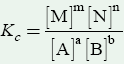
where Kc is a constant called the equilibrium constant.
When the equilibrium system of interest consists of gases, it is often convenient to express the concentrations of reactants and products interms of gas pressures:
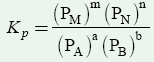
Kc and Kp are related by the expression Kp = Kc (RT)∆n
The value of the equilibrium constant changes with temperature. A large value of Kc indicates that the equilibrium mixture contains more products than reactants and therefore lies toward the product side of the equation. A small value for the equilibrium constant means that the equilibrium mixture contains less products than reactants and therefore lies toward the reactant side. The equilibrium constant expression and the equilibrium constant of the reverse of a reaction are the reciprocals of those of the forward reaction. If a reaction is the sum of two or more reactions, its equilibrium constant will be the product of the equilibrium constants for the individual reactions.
Equilibria for which all substances are in the same phase are called homogeneous equilibria; in heterogeneous equilibria two or more phases are present. The concentrations of pure solids and liquids are left out of the equilibrium-constant expression for a heterogeneous equilibrium.
The reaction quotient, Q, is found by substituting reactant and product concentrations or partial pressures at any point during a reaction into the equilibrium-constant expression. If the system is at equilibrium, Q = K.
If Q ≠ K, however, the system is not at equilibrium.
When Q < K, the reaction will move toward equilibrium by forming more products (the reaction proceeds from left to right); when Q > K, the reaction will proceed from right to left. Knowing the value of Keq makes it possible to calculate the equilibrium amounts of reactants and products.
Le Châtelier’s principle states that if a system at equilibrium is disturbed, the equilibrium will shift to minimize the effect of the disturbance according to this principle, if a reactant or product is added to a system at equilibrium, the equilibrium will shift to consume the added species. The effects of removing reactants or products and of changing the pressure or volume of a reaction mixture can be similarly deduced. For example, if the volume of the system is reduced, the equilibrium will shift in the direction that decreases the number of gas molecules.
The enthalpy change for a reaction indicates how an increase in temperature affects the equilibrium: For an endothermic reaction, an increase in temperature shifts the equilibrium to the right; for an exothermic reaction, a temperature increase shifts the equilibrium to the left. Catalysts affect the speed at which equilibrium is reached but do not affect the magnitude of Keq.
 Browse Chapter