E-Lecture - Leaf Classification and arrangement on Stem
Leaf classification
A leaf is any usually flattened green outgrowth from the stem of a vascular plant. As the primary sites of photosynthesis, leaves manufacture food for plants, which in turn ultimately nourish and sustain all land animals. Leaves are an integral part of the stem system. They are attached by a continuous vascular system to the rest of the plant so that free exchange of nutrients, water, and end products of photosynthesis can be carried to its various parts. Leaves may be simple or compound.
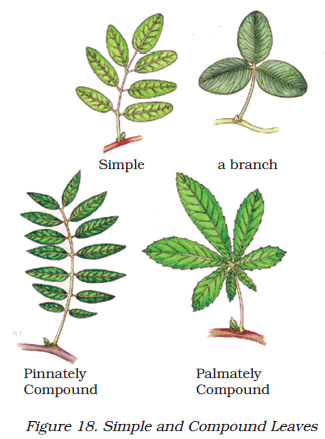
Simple Leaf
A simple leaf is described as a single lamina attached to a stem by one petiole. There is no division in the lamina or leaf blade. Some examples of simple leaves include pear, oak, guava, and oregano.
Compound Leaf
A compound leaf is a divided leaf blade where the divisions are called leaflets. Two or more leaflets are attached to the midrib or main vein, which is attached to the petiole.
Leaf arrangement
Phyllotaxy is the term used to describe the arrangement of leaves around the stem. The proper arrangement of leaves is important for providing sunlight and photosynthesis. Leaves arise from the node of the stem. They develop from the shoot apical meristems. Leaves have axillary buds that develop into branches.
The three main types of leaf arrangement are:
Alternate – a single leaf originates at each node and leaves are arranged in an alternate fashion. E.g. mustard, china rose, sunflower, etc.
Opposite – two leaves arise at each node and they lie opposite each other. E.g. guava, Calotropis, etc.
Whorled – more than two leaves arise at each node and form a whorl, e.g., Alstonia
 Browse Chapter