E-Lecture - Product Law of Logarithm
If a, x and y are positive real numbers, where a ≠ 1, then
loga (xy) = loga x + loga y.
Suppose
x = am and y = an,
then their equivalent logarithmic forms are
loga x = m and loga y = n
Consider x ÷ y.
Using the quotient property of indices, we get

Power Law of Logarithm
If a and x are positive real numbers, where a ≠ 1, and k is any real number, then
loga xk = k loga x.
The next law of logarithms, tells us how logarithms to different bases are related.
Change of Base Law of Logarithm
If x, a and b are positive real numbers, where a ≠ 1 and b ≠ 1, then
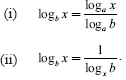
This law enables us to calculate the logarithm of a number to any base from a calculator which calculates the logarithm of a number to only one base.
 Browse Chapter