E-Lecture - Important Points
- If a is any real number and n is any natural number, then the nth power of a, denoted by an, read as “a to the power of n” is defined as:
.PNG)
- In the expression an, a is called the base, n is called the index or exponent and an is the power.
- The growth of population, P, at the end of t years with growth rate r can be given by the formula:
P = P0(1 + r)t,
where P0 is the original number of populations. - If a principal P is invested at an annual rate of r, compounded annually, then the amount after t years is given by
A = P(1 + r)t - An exponential growth or decay function is a function that grows or shrinks at a constant percent growth rate. The equation can be written in the form
y = abx,
where, a is the initial or starting value, b is the growth factor and x is the number of time intervals that have passed. - Any nonzero number raised to a negative exponent is the reciprocal of the same power with positive exponent. That is, for a ≠ 0 and n > 0,
.PNG)
(i) For a ≠ 0,
.PNG)
(ii) If a and b are nonzero real numbers, then it is always true that for n > 0.
.PNG)
- The Product Property of indices
(i) For any real number a and natural numbers m and n, the product property of indices states that
am × an = am+n
(ii) For any real number a and natural numbers m and n such that m > n, the quotient property of indices states that
.PNG)
(iii) For any real number a and natural numbers m and n, the power property of indices states that
(am)n = am´n
(iv) For any real numbers a and b and a natural number n, the power of a product property of indices states that
(ab)n = anbn
(v) For any real numbers a and b and a natural number n, the power of a quotient property of indices states that
.PNG)
(vi) For any nonzero real numbers a, the zero-index property of indices states that
a0 = 1. - If n is a positive even integer and a is positive, then
 denotes the positive real nth root of a and is called the principal nth root of a. If n is a positive odd integer and a is any real number, then denotes the real nth root of a.
 - If m and n are positive integers, then

provided that is a real number.
(i) is not real when a is negative and n is even. According to the definition of rational power, expressions such as
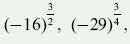
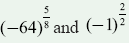
are not defined because each of them involves an even root of a negative number.
(ii) For a fixed positive number b ≠ 1 and for every real number a > 0,
c = logb a if and only if bc = a - If x and a are positive real numbers such that a ≠ 1, then y = f (x) = logax is called the logarithmic function with base a, and y = loga x if and only if ay = x.
- Basic Properties of the Logarithmic Functions f (x) = logbx; b > 0 and b ≠ 1
(i) The domain is the set of all positive real numbers., {x ∊ ℝ : x > 0}.
(ii) The range is the set of all real numbers, ℝ.
(iii) The graph intersects the x-axis at a point (1, 0). Thus, the x-intercept is (1, 0).
(iv) The graph never cross or touch the y-axis. Thus, there are no y-intercepts.
(v) The graph is smooth curves and continuous with no corners and gaps.
(vi) If a > 1, then the logarithmic function is an increasing function.
(vii) If 0 < a < 1, then the logarithmic function f is a decreasing function.
(viii) (a) If 0 < x < 1, then y = log2 x < 0 and y = -log2 x > 0.
(b) If x > 1, then y = log2 x > 0 and y = -log2 x < 0. - For any x > 0, the common logarithm of x is defined as logarithm of x to the base 10. That is, log10x or log x.
- The common logarithm of a number x is the power or exponent to which “10” has to be raised to be equal to x. Logarithms to base 10 are called common logarithms.
- A way of expressing numbers N in the form N = a × 10n, where 0 < a < 10 and n is an integer, is said to be scientific notation. If a number is greater or equal to 1, then n which is the power of 10, is positive.
 Browse Chapter