E-Lecture - Circles Arcs And Sectors
A circle has always been an important shape among all geometrical figures. There are various concepts and formulas related to a circle. The arcs and sectors are the most useful of them. In this sub-topic, we shall focus on the area and circumference of a circle, arc length and area and perimeter of a sector of a circle.
Circumference and area of a circle
The ratio of the circumference of a circle to the length of its diameter is a unique positive constant. This constant is represented by the Greek letter π (pie). π is the ratio between the circumference C and the diameter length d of any circle. Thus,
In the following theorem, the lengths of the diameter and radius of the circle are
represented by d and r, respectively and, d = 2r.
The circumference, C of a circle is given by the formula
C = πd or C = 2πr.
The area A of a circle whose radius has length r is given by
A = πr2.
Arc length of a circle
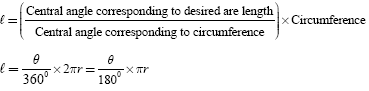
Just as the length of an arc is part of the circle’s circumference, the area of a sector is part of the area of this circle. In degree measure one complete revolution is 3600 and the circumference of a circle with radius r is 2πr. The arc length corresponding to θ is computed as follows:
Perimeter and area of a sector of a circle
A sector of a circle is the area bounded by two radii and the arc intercepted between them as shown by the shaded region in Figure 78:
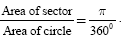
The angle of the sector is the angle contained by the two radii of the circle and is the same as the ratio of the area of the sector to the area of the circle. That is,
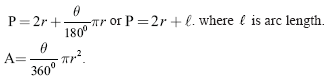
The perimeter, P and area, A of a sector, whose central angle θ and radius r is given by:
 Browse Chapter