E-Lecture - Intermolecular forces
Inter-molecular forces are relatively weak forces of attraction that occur between molecules.
Inter-molecular forces vary in strength but are generally weaker than the bonds that join atoms in molecules, ions in ionic compounds, and metal atoms in solid metals. Inter-molecular forces acting between molecules include:
- dipole-dipole forces,
- London dispersion forces and
- hydrogen bonding.
Dipole-dipole attractions and London forces are collectively called Van der Waal’s forces.
A. Dipole-dipole forces
Dipole-dipole forces are strong inter-molecular forces between polar molecules. A dipole is created by equal but opposite charges separated by a short distance. A polar molecule acts as a tiny dipole because of its uneven charge distribution.
The negative end in one polar molecule attracts the positive end in an adjacent molecule in a liquid or solid. Dipole-dipole forces occur in molecules such as ethyl alcohol and water.
B. London dispersion forces
All molecules, including those without dipole moments, exert forces on each other. We know this because all substances, even the noble gases, change from liquid to solid state under different conditions.
London dispersion forces act between all atoms and molecules. They are the only forces that exist between noble gas atoms and non-polar molecules. This fact is reflected in the low boiling points of noble gases and non-polar molecules. Because dispersion forces result from temporary redistribution of the electrons causing induced dipole-dipole interactions, their strength increases with the number of electrons in the interacting atoms or molecules.
C. Hydrogen bonding
Do you think that the intermolecular forces between molecules containing C-H, N-H, and O-H bonds are as strong as the intermolecular forces containing F-H bonds?
Hydrogen bonding is a particular type of intermolecular force arising when a hydrogen atom is bonded to highly electronegative elements, fluorine, oxygen and nitrogen. Hydrogen bonding is a particular type of dipole-dipole interactions between polar compounds. In such compounds, large electronegativity differences between the hydrogen and the fluorine, oxygen, or nitrogen atoms make the bonds connecting them highly polar.
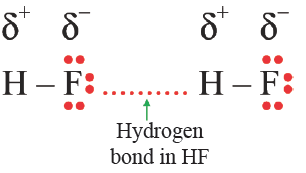
Hydrogen bonds are usually represented by dotted lines connecting the hydrogen atom to the unshared electron pair of the electronegative atom to which it is attracted.
For example, the hydrogen bond in hydrogen fluoride, HF, results when the highly electronegative F atom attracts the H atoms of an adjacent molecule.
 Browse Chapter