E-Lecture - Metam orphosis and Molting
Metamorphosis is the process of development of an organism that involves distinct stages with an abrupt change between them. In arthropods the animal moves between stages by moulting its exoskeleton. The new exoskeleton will have developed beneath the old skin. After moulting the new skin is inflated and then hardens. Complete metamorphosis and incomplete metamorphosis are two growth types of insects where the body form of insects changes during their lifecycle.
Complete Metamorphosis
Complete metamorphosis is the type of insect development that includes egg, larva, pupal, and adult stages, which differ greatly in morphology. The lifecycle of butterflies, ants, fleas, bees, beetles, moths, and wasps are examples of the complete metamorphosis. The lifecycle of ants is shown.

Incomplete Metamorphosis
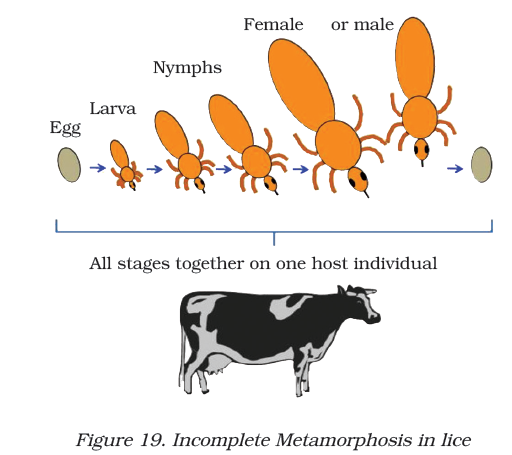
Incomplete metamorphosis refers to a type of insect development in which gradual changes occur in the insect during the development from the egg to the adult. The three stages of the incomplete metamorphosis are egg, nymph, and adult. The eggs are laid by the female insect. In most cases, the eggs are covered by an egg case, which protects and hold the eggs together. The eggs hatch into younger nymphs. The nymph resembles the adult without wings. The nymph is also smaller than the adult. The nymph eats the same food as the adult. It develops into the adult through a series of molts. It shed its exoskeleton 4-8 times. When it becomes an adult, the molting does not occur. Insects that have an incomplete metamorphosis life cycle include true bugs, grasshoppers, cockroaches,termites, praying mantises, crickets, and lice. The incomplete metamorphosis of lice is shown in.
Molting
One of the general characteristics that defines the phylum Arthropoda (which includes insects, spiders, and crustaceans) is an external skeleton, also called an exoskeleton. The arthropod exoskeleton completely covers the outside of the body and the muscles inside adhere to it. Exoskeletons are hard and protect the body. Becausethe exoskeleton is hard and rigid, an arthropod cannot grow unless it sheds its old exoskeleton and secretes a new one. This process is called molting.
 Browse Chapter