E-Lecture - Laboratory apparatus and safety measures
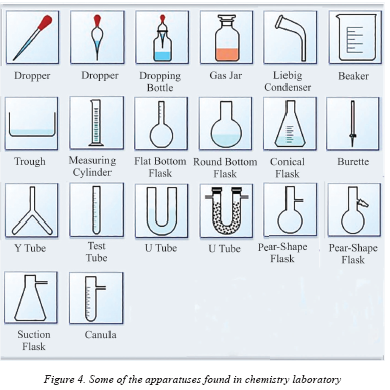
What is a laboratory apparatus ? The following are some of the apparatus commonly used in chemistry laboratories.
Beakers are useful as a reaction container or to hold liquid or solid samples. They are also used to catch liquids from titrations and filtrates from filtering operations.
Bunsen burners are sources of heat.
Burette are used for addition of a precise volume of liquid. The volume of liquid added can be determined to the nearest 0.01 mL with practice.
Clay triangles are placed on a ring attached to a ring stand as a support for a funnel, crucible, or evaporating dish.
Droppers are for addition of liquids drop by drop.
Hot plates can also be used as sources of heat when an open flame is not desirable.
Pipette are used to dispense small quantities of liquids.
Ring stand with rings are for holding pieces of glassware in place.
Test tubes are for holding small samples or for containing reactions.
Test tube holders are for holding test tubes when tubes should not be touched.
Tongs are similar in function to forceps but are useful for larger items.
Wash bottles are used for dispensing small quantities of distilled water.
Wire gauze on a ring supports beakers to be heated by Bunsen burners.
Safety Rules inside the Laboratory
- Clean up your work area before leaving
- Wear safety glasses/goggles
- Wear gloves when using any hazardous or toxic agent
- Turn off gas when not in use
- Disposal – Students are responsible for the proper disposal of used material if any in appropriate containers
- Read labels carefully
- Tie back long hair
- Never eat, drink, or smoke while working in the laboratory
- Keep bags away from burners
- The use of personal audio or video equipment is prohibited in the laboratory
- The performance of unauthorized experiments is strictly forbidden
- Never work in the laboratory without the supervision of an instructor
- Do not leave lit Bunsen burners unattended
 Browse Chapter