E-Lecture - The Integrated Rate Law
A rate law tells us how the rate of reaction depends on the concentration of the reactants at a particular moment. But, often we would like to have a mathematical relationship that shows how a reactant concentration changes over a period of time. A rate law can be transformed into a mathematical relationship between concentration and time using calculus. Therefore, an integrated law relates concentration to reaction time.
We will proceed by first looking at reactions involving a single reactant:
A → products
The above reaction have a rate law of the form:

We will develop the integrated rate laws individually for the cases n = 1 (first order), n = 2 (second order), and n = 0 (zero order).
(a) First-order rate laws
A first-order reaction is a reaction whose rate of reaction depends on the reactant concentration raised to the first power. For a chemical reaction of the form:
A → products
There are three important things to note about integrated rate equation for 1st order reaction
1. The equation shows how the concentration of A depends on time. If the initial concentration of A and the value of the rate constant k are known, the concentration of A at any time can be calculated.
2. The equation ln [A] = -kt + In[A]0 has the form of the linear equation y = mx + b, in which m is the slope of the line that is the graph of the equation. Thus, a plot of ln [A] versus t gives a straight line with a slope of k (or m). This graphical analysis allows us to calculate the rate constant k. Figure 9 shows the characteristics of first-order reactions.

Figure 9. Plot for a reaction that is first-order with respect to A
The observation that plot of ln[A] versus time is a straight line confirms that the reaction is first-order in A and first-order overall, i.e., Rate = k[A]. The slope is equal to –k. Conversely, if the plot is not a straight line, the reaction is not first order.
3. The integrated rate law for a first-order reaction can also be expressed in terms of the ratio of [A] and [A]0 as follows:

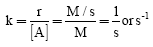
For a first order reaction, r = k[A]. To obtain the units of k for this rate law, we write
(b) Half-life of a first-order reaction
The time required for a reactant to reach half of its original concentration is called the half-life of a reaction and is designated by t1/2.
This is the general equation for the half-life of a first-order reaction. This equation can be used to calculate t½ if k is known, or k if t½ is known. Note that for a first-order reaction the half-life does not depend on concentration.
(c) Second-order rate laws
Note the following characteristics of the integrated second-order rate law:
1. A plot of 1/[A] versus t will produce a straight line with a slope equal to k.

Figure 10. A Plot for a reaction that is second-order with respect to A
and overall a second-order reaction.
2. The integrated second-order rate equation shows how [A] depends on time and can be used to calculate [A] at any time t, provided k and [A]0 are known.
r = k[A]2
From the rate law

(d) Second order half-life
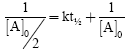
When one half-life of a second-order reaction has elapsed (t = t½), by definition, [A] = [A]0/2. The integrated second-order rate law then becomes
and

Solving for t½ gives the expression for the half-life of a second-order reaction:

 Browse Chapter