E-Lecture - Determining the Form of the Rate Law
Most often, chemists obtain experimental data and determine the rate law. The first step is to determine the order by deciding which exponent explains the observed behavior. Suppose a reaction of the type,
A → products
is under study. The data are inspected to find how the initial rate varies with the initial concentration of A, [A]0. The objective is to find the value of the exponent in the rate equation, rate = k[A]n, where n is the order of the reaction. Table 1 shows the dependence of rate on concentration when the value of the rate constant (k) is 1.
First, we will consider the decomposition of dinitrogen pentoxide in carbon tetrachloride solution:
2N2O5(soln) → 4NO2(soln) + O2(g)
Evaluation of the reaction rates at N2O5 concentrations of 0.90 M and 0.45 M, by taking the slopes of the tangents to the curve at these points, yields the following data:
| [N2O5] | Rate (mol L-1 s-1) |
| 0.90 M | 5.4 × 10⁻⁴ |
| 0.45 M | 2.7 × 10⁻⁴ |
Note that when [N2O5] is halved, the rate is also halved. This means that the rate of this reaction depends on the concentration of N2O5 to the first power. In other words, the (differential) rate law for this reaction is:
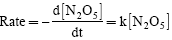
Thus the reaction is first order w.r.t. N2O5.
Method of initial rates
One widely used method of determining the order of a reaction is called the initial rate method. The technique utilizes several experiments in which the initial concentrations of all substances are accurately known but are different in each experiment.
To use this method, we select two sets of rate data that differ in the concentration of only one reactant and set up a ratio of the two rates and the two rate laws. After cancelling terms that are equal, we are left with an equation that contains only one unknown, the coefficient of the concentration that varies. We then solve this equation for the coefficient.
 Browse Chapter