E-Lecture - Fungi
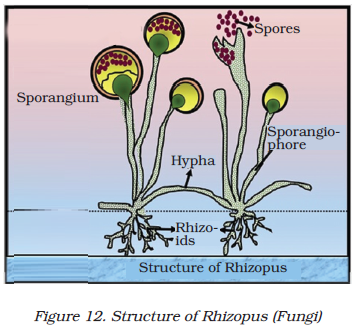
Fungi: are achlorophyllous, heterotrophic, eukaryotic thallophytes. They are non-green in color with the capacity to live in all kinds of environments. They generally feed on dead and decaying organic matter. The structure of fungi can be explained in the following points:
- Almost all the fungi have a filamentous structure except the yeast cells.
- They can be either single-celled or multicellular organisms.
- Fungi consist of long thread-like structures known as hyphae. These hyphae together form a mesh-like structure called mycelium.
- Fungi possess a cell wall which is made up of chitin and polysaccharides.
- The cell wall comprises a protoplast, which is differentiated into other cell parts such as cell membrane, cytoplasm, cell organelles and nuclei.
- The nucleus is dense, clear, with chromatin threads. The nucleus is surrounded by a nuclear membrane.
General characteristic of Fungi
Following are the important characteristics of fungi:
- Fungi are eukaryotic, non-vascular, non-motile and heterotrophic organisms.
- They may be unicellular or filamentous.
- They reproduce by means of spores.
- Fungi exhibit the phenomenon of alternation of generation.
- Fungi lack chlorophyll and hence cannot perform photosynthesis.
- Fungi store their food in the form of starch.
- Biosynthesis of chitin occurs in fungi.
- The nuclei of the fungi are very small.
- The fungi have no embryonic stage. They develop from the spores.
- The mode of reproduction is sexual or asexual.
- Some fungi are parasitic and can infect the host.
Examples include mushrooms, molds and yeast
 Browse Chapter