E-Lecture - Gradient of a Straight Line
In the previous section, we have seen that the graph of a linear function f(x) = ax+b is a straight line which is inclined with certain sort of steepness. A measure of this steepness is the property called gradient or slope. In this section, we will discuss a way of finding the gradient of a line.
Note: In the sequel, we may use the term ‘slope’ for gradient, a’ line’ for straight line, and the symbol ∆ (read ‘delta’) means “the change in”. For instance, ‘∆x’ means ‘the change in x’.
From geometry, you know that two distinct points in a plane determine a unique line. So, any two distinct points (x1, y1) and (x2, y2) that lies on a line can be used to describe the line and to define the slope of the line.
For any two distinct points (x1, y1) and (x2, y2) on a line, we define
∆x = x2 - x1 (change in the values (coordinates) of x)
∆y = y2 - y1 (change in the values (coordinates) of y)
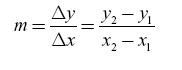
The slope, denoted by m, of a line L that passes through point (x1, y1) and (x2, y2) is defined by
.JPG)
 Browse Chapter